Key Info
Bachelor of Arts in Music
What is this course about?
The BA Music is a globally conceived contemporary performance based music programme. The BA Music welcomes students with or without previous formal music education from all musical backgrounds including early music, western classical, pop, rock, metal, hip-hop, experimental music, jazz, folk, traditional musics, electronica, or others. The aim of the programme is to enable students to navigate their own path as artists in the contemporary global creative sector.
Throughout the four years of the course, students develop their performance skills by taking individual lessons on their own main instrument (including percussion and voice). Students study a wide range of music theory related to classical, popular and other global traditions, including western keyboard theory, Jazz, Indian Classical and Middle Eastern music and more.
Group-playing is a core aspect of the course. Students participate in a wide range of ensembles, including Popular Music Ensemble, Jazz Ensemble, Javanese Gamelan from Indonesia, Electroacoustic Ensemble, Middle Eastern and Balkan Music, Early music, Ewe Drumming from Ghana, Indian Classical Ensemble and an Inter-Arts Ensemble. Students also have regular masterclass workshops with international artists from a wide variety of world music traditions.
Students also receive individual lessons on a choice of world music instruments and can learn diverse repertoire such as: ragas on the North Indian lute called the sarode, early music on the harpsichord, gypsy jazz on the violin, West African rhythms on the djembe and Javanese court music on the two-stringed bowed fiddle, the rebab.
BA Music students are introduced to critical thinking and scholarship through the academic study of a wide range of world musics including classical, traditional and popular music forms. Specialist modules include Global Pop Music, Traditional music, Western Art music philosophy, Ethnomusicology and World Music Survey. Students are encouraged to develop their own niche area of specialist interest through independent studies and project-based work.
Why study Music?
Students on the BA Music develop their scholarly and theoretical knowledge of music while also taking a number of vocational modules that will support them in the development of a fulfilling career. This course develops students’ music skills and knowledge of their own current, chosen style(s) of music while broadening their musical horizons through playing and learning about music from around the world.
Individual lessons, ensemble tuition and academic lectures are delivered by a team of accomplished professional musicians with extensive teaching and performance experience in a wide range of music genres. Students are based at the world-class Irish World Academy, with its cutting-edge performance and rehearsal spaces, and state-of-the-art technological infrastructure. In addition, this course offers work experience and students have the option to study abroad for one semester as part of UL’s Exchange and Erasmus partnerships.
Learn more about our courses and upcoming events
What you will study
Throughout the four years of the programme, you will develop your performance skills by taking individual lessons on your own instrument (or voice), and you will also receive individual lessons on a choice of world music instruments, such as the North Indian plucked stringed instrument sarode, the West African djembe drum and the Javanese two-stringed bowed fiddle rebab.
Group-playing is a core aspect of the BA Music. Throughout the four years of the programme you will participate in a wide range of ensembles, including Javanese Gamelan from Indonesia, Middle Eastern and Balkan Music, Ewe Drumming from Ghana, World Popular Music Ensemble and West African Drumming. You will also have the opportunity to choose to participate in performance classes in the areas of Irish traditional music and dance, voice studies and contemporary dance.
You will be introduced to the academic study of a wide range of world musics, as well as classical music, popular music and traditional musics. Specialist modules for BA Music students include Global Pop Music, Ethnomusicology and World Music Survey. You will also study a wide range of music theory related to classical and popular music, Indian and Middle Eastern music, and more.
In addition to your core modules, over the four years of the programme, BA Music students join students studying on the voice, dance and Irish traditional music programmes to take a range of modules in arts-related technology, professional and research skills, education and the role of arts in health and wellbeing. Every semester, you will also have the opportunity to choose elective modules from a broad of range of options, covering history, languages, sociology, performance practice, choreography, composition etc.
Cooperative Education – Work experience
In their 3rd year, Irish World Academy performing arts students go on ‘co-op’, a university-wide module specifically designed for undergraduates to engage in real-world, professional environments. The Cooperative Education division, in consultation with the Academy, helps students to identify working opportunities in a variety of contexts, including arts management, education, performance, media and related fields. Students are encouraged to set up their own six-month placements or to engage in split placements (ideally no more than two placements) in order to explore if their expectations for future careers match the experiences they have during the co-op period. Faculty visits, pre- and post- co-op assessment skills, and final report help students to reflect upon the process, enabling them to critically evaluate their time off campus.
Year 2
| Semester 5 | Semester 6 | |
Coopearative Education Work Placement | Core Modules | |
| MD4106 | PERFORMANCE 5A | |
| MD4116 | IRISH WORLD ACADEMY PRACTICUM C5 | |
| MU4013 | RESEARCH SKILLS: ETHNOMUSICOLOGY/ETHNOCHOREOLOGY/ARTS PRACTICE | |
| MU4106 | ARTS AND HEALTH | |
| Electives | Choose one elective | |
| AW4001 | ACADEMIC LITERACIES 1 | |
| AW4002 | ACADEMIC LITERACIES 2 | |
| EH4036 | IRISH LITERATURE 1930 - 1990 | |
| FR4146 | FRENCH LANGUAGE AND SOCIETY 4 MODERN CONTEMPORARY | |
| GA4105 | IRISH FOLKLORE 1 | |
| GA4146 | TEANGA, SOCHAí AGUS SAÍOCHT 4 | |
| GE4146 | GERMAN LANGUAGE AND SOCIETY 4: GERMANY PAST AND PRESENT | |
| JA4246 | JAPANESE LANGUAGE, CULTURE AND SOCIETY 4 | |
| MD4044 | TRAVELLER MUSIC STUDIES | |
| MD4093 | CLASSICAL MUSIC STUDIES | |
| MD4094 | MUSIC, LANGUAGE, SIGN AND TEXT | |
| MK4045 | DIGITAL MARKETING | |
| MU4018 | SECOND INSTRUMENT STUDIES TWO | |
| MU4022 | INTRODUCTION TO SONGWRITING 2 | |
| MU4054 | MUSIC COMPOSITION 2 | |
| MU4063 | SELF-DIRECTED PROJECT | |
| MU4074 | CROSS-ARTS ENSEMBLE 2 | |
| MU4076 | CROSS-ARTS ENSEMBLE 3 | |
| MU4104 | SELF DIRECTED PROJECT 3 | |
| TE4011 | ENGLISH AS A FOREIGN LANGUAGE 1 (INTERMEDIATE) |
Frequently Asked Questions
You need to have experience in performing before embarking on this course.
No. In the case of Irish Music, Irish Dance, Contemporary Dance and Voice, you need to show proficiency in one area. In the case of World Music, you will be required to show proficiency in any genre of music. An open mind and a willingness to engage with other genres and disciplines is also a requirement.
The first year of the programme is shared by all musicians, singers and dancers but you will specialise in your own performance genre from the start. At the beginning of the second year, students will be divided into their specialist area, in one of the following streams:
• Irish Traditional Music
• Irish Traditional Dance
• Contemporary Dance
• Voice
• World Music
Each student receives weekly classes from highly accomplished vocalists, musicians and dancers with extensive teaching and performance experience for their main performance area. Master classes are also provided by visiting professional vocalists, musicians and dancers throughout each semester.
Yes, each student has the opportunity to gain work experience in their area of interest in Semester 5 during their Co-operative Education placement, i.e. the 1st Semester of 3rd Year.
Yes. Each student is given the option of studying at a number of institutions around the world for Semester 6, i.e. the 2nd Semester of 3rd Year.
No, you will also engage in academic classes. Performance and academic studies are equally important. This gives you more career opportunities upon completing the course.
Auditions normally take place at the beginning of April or in mid-July for late applicants and ‘change-of-mind’ applications although the Academy is flexible if applicants have difficulty with these dates. In auditions students should show a good standard of performance in one of the five pathways opened to students in the programme. Students who wish to follow the World Music pathway can perform in any music or dance genre and not necessarily one associated with the term ‘World Music’. The audition itself takes the form of a solo performance of no more than 10 minutes duration, a 10 minute interview and then some element usually specific to the performance pathway the student intends to follow. For example: dancers will meet a physiotherapist in order to assess their physical suitability to the dance pathways; students for the vocal pathway will have a short choral workshop with other applicants where they will work on a single piece of repertoire; traditional musicians may be given a short oral test where they comment on recorded pieces of music played to them by faculty. Students who intend to follow the world music stream will also have a short oral test.
Further information can be found at Irish World Academy.
Entry requirements
| CAO points history |
348 (Audition required)
|
|---|---|
| Minimum grades |
Applicants are required to hold at the time of enrolment the established Leaving Certificate (or an approved equivalent) with a minimum of six subjects which must include: Two H5 (Higher level) grades and Four O6 (Ordinary level) grades or four H7 (Higher Level) grades. Subjects must include Mathematics, Irish or another language, and English Note: Grade F6 in Foundation Mathematics also satisfies the minimum entry requirements. Foundation Maths is not reckonable for scoring purposes. |
| Additional considerations |
Auditions will take place on 11th and 12th April 2026. Applicants will be required to show proficiency in their own music style(s) at the audition. The audition takes the form of a 10-minute solo performance and a 10-minute interview. Applicants are encouraged to choose to perform pieces that best represent their musical abilities and interests. Applicants will also be asked to speak about their musical interests and how the BA Music will serve their musical development BA World Music (LM135) Audition Process for Entry All applicants who apply through the CAO will be called for audition that will be conducted by either submitting online or a face-to-face process. In-person applicants will play/sing two pieces of your own choosing in any style or genre. Online applicants will be invited to submit a video recording of their performance of two songs and attend a remote interview. After your audition, the Admissions Department of the University will contact you to let you know the outcome. Audition Points Framework Applicants can be awarded a maximum of 200 audition points. Key areas to be assessed at BA World Music audition:
All students must undergo a Garda Vetting process. Mature StudentsWe welcome applications from mature students. Mature applicants must apply through the Central Applications Office (CAO) by 1 February. Application information for mature student applicants QQI EntryCertain QQI Awards are acceptable in fulfilling admission requirements for this programme. Go to the UL Admissions QQI page for a full list of modules. |
| Non-EU Entry Requirements |
|
How to apply
| Where are you applying from? | How to Apply |
|---|---|
| Ireland | Irish students must apply to UL via the CAO. More information can be found here. |
| The UK | Students who have completed their A-Levels can apply to UL via the CAO. More information can be found on the Academic Registry website. |
| The EU | EU Students can apply to UL via the CAO. More information can be found on the Academic Registry website. |
| Non-EU country | If you are outside of the EU, you can apply for this degree here. |
Fees and funding
Student course fees are broken into three components - Student contribution, Student Levy and Tuition Fees.
A number of illustrative examples of fees for this course based on the current fee levels have been set out in the tables below.
An explanation of the components, how to determine status and the criteria involved is provided below the examples as is a list of possible scholarships and funding available.
EU Students with Free fees status in receipt of a SUSI grant
| HEA pays | Tuition Fees | €4,762 |
| SUSI pays | Student contribution | €2,500 |
| Student pays | Student Levy | €104 |
| Total | €7,366 |
EU Students with Free fees status not in receipt of a grant
| HEA pays | Tuition Fees | €4,762 |
| Student pays | Student contribution | €2,500 |
| Student pays | Student Levy | €104 |
| Total | €7,366 |
Students with EU fee status not in receipt of a grant
| Student pays | Tuition Fees | €4,762 |
| Student pays | Student contribution | €2,500 |
| Student pays | Student Levy | €104 |
| Total | €7,366 |
Non-EU Students
| Student pays | Tuition Fees | €22,596 |
| Student pays | Student Levy | €104 |
| Total | €22,700 |
Student course fees are comprised of the following components:
Student Contribution
Annual charge set by the government for all full-time third level students. All students are liable unless they have been approved for a grant by Student Universal Support Ireland (SUSI). Please refer to https://www.studentfinance.ie to determine your eligibility for a grant and for instructions on how to apply. The current student contribution is set at €2,500.
Student Levy
All students are liable to pay the Student Levy of €104. Please note the Student Levy is not covered by the SUSI Grant.
Tuition Fees
These are based on Residency, Citizenship, Course requirements.
Review the three groups of criteria to determine your fee status as follows
-
Residency
- You must have been living in an EU/EEA member state or Switzerland for at least 3 of the 5 years before starting your course
-
Citizenship
- You must be a citizen of an EU/EEA member state or Switzerland or have official refugee status
-
Course Requirements
(all must be met)
- You must be a first time full-time undergraduate (Exceptions are provided for students who hold a Level 6 or Level 7 qualification and are progressing to a Level 8 course in the same general area of study).
- You must be undertaking a full-time undergraduate course of at least 2 years' duration
- You cannot be undertaking a repeat year of study at the same level unless evidence of exceptional circumstances eg serious illness is provided (in which case this condition may be waived)
Depending on how you meet these criteria your status will be one of the following -
- Free Fee Status: You satisfy all three categories (1, 2 and 3) and therefore are eligible for the Higher Education Authority’s Free Fees scheme.
- EU Fee Status: You satisfy both the citizenship and residency criteria but fail to satisfy the course requirements and are liable to EU fees.
- Non EU Fee Status: You do not meet either the citizenship or residency criteria and are therefore liable to Non EU fees.
More information about fees can be found on the Finance website
These scholarships are available for all courses
| Title | Award | Scholarships Available |
|---|---|---|
| All Ireland Scholarships - sponsored by J.P. McManus | €6,750 | 125 |
| Bursary for my Future Scholarship | €2,750 one off payment | 4 |
| Civic Engagement Scholarship | €1500 | 1 |
| Cooperative Education Award | 1 medal per faculty | |
| Elaine Fagan Scholarship | €1,500 | |
| Hegarty Family Access Scholarships | €5,000 for one year | 2 |
| Higher Education Grants & VEC Grants | ||
| Irish American Partnership Access Scholarships | €5,000 | 2 |
| Love Actually Charity (LAC) Scholarship | €1,000 | 3 |
| Paddy Dooley Rowing Scholarship | €2,500 | |
| Plassey Campus Centre Scholarship Programme | ||
| Provincial GAA Bursaries Scheme | €750 | |
| Stuart Mangan Scholarship | ||
| The Michael Hillery and Jacinta O’Brien Athletics Scholarship | Various benefits equating to over €7,000 in value | |
| UL Sports Scholarships | Varies depending on level of Scholarship | Multiple |
Your future career
What can I do after this course?
The programme prepares graduates for many different career paths in areas including professional performance, composition, project-based artist work, inter-disciplinary collaboration, academia, arts curation and management, media, archive work, music production, and combinations of these.
- Professional Performance
- Further Study (MA, PhD)
- Music/Dance Therapy
- Community Music/Dance
- Music/Dance teacher
- Arts administration
- Performance management and promotion
- Backstage work in performance theatre e.g. sound engineer
- Music Technology, e.g. recording studio producer/technician
- Media (TV, Radio etc.)
- Work in cultural institutions and archives
To find out more, visit The Irish World Academy of Music and Dance
Follow on study
- Master of Arts Irish Traditional Dance Performance
- Master of Arts Irish Traditional Music Performance
- Master of Arts Contemporary Dance Performance
- Master of Arts Irish Music Studies
- Master of Arts Irish Dance Studies
- Master of Arts Ethnochoreology
- Master of Arts Ethnomusicology
- Master of Arts Ritual Chant and Song
- Master of Arts Community Music
- Master of Arts Music Therapy
- Master of Arts Festive Arts
- Master of Arts Classical String Performance in association with the Irish Chamber Orchestra
- Professional Master of Education in Music
- PhD Arts Practice
- PhD Research
Graduate Profile
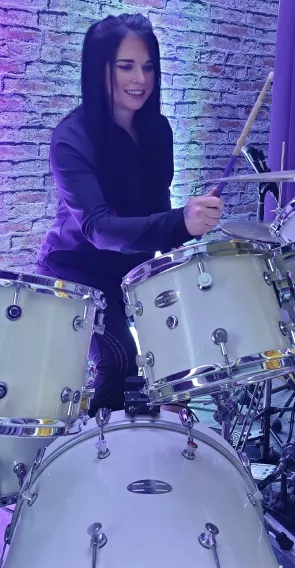
Deanna McDonagh - BA World Music Graduate
The BA World Music was the obvious choice for me when choosing a university course in music. Being a percussionist, and having a passion for rhythms of different origins, this course gave me so many opportunities to explore the different music cultures across the world, both practically and theoretically. It was a privilege to study in the Irish World Academy building itself, which provides so many wonderful resources, from practice rooms, theatres and recording studios, to keyboard studios and dance rehearsal spaces and so much more. The World Music course was the perfect pathway for me to pursue my career as both a professional drummer and drum teacher, with all the amazing teaching that was provided at the Academy. Working alongside so many outstanding tutors not only improved my performance skills and music knowledge, it also increased my confidence as a performer in composing my own drum music. Since graduating from the Irish World Academy, I am now the lead one-to-one drum kit teacher in a drumming company in Galway called Drumadore, teaching on a daily basis. I am also a part-time leader with the theatrical company, Macnas, and I drum professionally in two bands, one being formed in the Academy with two other BA World Music graduates. After graduating, this course has given me a chance to advance and progress in my career of being a percussionist.
Valeriia Tkachenko BA World Music
I am a second-year student on the BA in World Music. We focus on many different genres and traditions including western, Indian, Indonesian and African music. In my first year, I took three instruments: the guitar, the Irish tin whistle and voice classes but this year, I have taken the guitar, focusing on improvisational skills and electronic practice.
Every semester, we are exposed to a broad range of subjects and genres and are given space to be creative. This course has opened up so many opportunities for me; I have truly been able to grow as a musician thanks to the flexibility it offers.
It is the perfect course to find yourself as a musician and the Irish World Academy of Music and Dance is so welcoming. Students have a great connection with lecturers, they are always there for advice. We also have amazing guest lecturers and masterclasses.
I have even had a masterclass with the Grammy Award-winning artist Rhiannon Giddens. The Academy building itself is purpose built so we have all of the equipment, theatres and practice space we need. It is an extremely deep course.
We look at world music from many different perspectives including politics, social studies and social conflicts. My advice for incoming students is to never be afraid of improvisation. This course is for you if you want adventure and want to learn more about musical traditions from around the world.


Eilidh Pope
Violinist, composer and singer-songwriter, Eilidh Pope, is a graduate of UL's BA in World Music, which is now the BA in Music. The Tipperary native is one third of cliodhnas.wav, a music project that was born in UL's Irish World Academy with two other UL graduates.
While in her final year of secondary school, Eilidh was unsure if college was for her but her passion for music led her to UL's Irish World Academy where she could further her practice as a violinist and her musicianship as a whole.
She says: "My time spent in UL and the Irish World Academy was a truly invaluable experience due to the fact I had four years in which all I did was think about music all day, every day – being given the time and space to explore my own artistic practice and interests whilst also broadening my entire understanding of what music was."